Part Two: What To Do About Our Planetary Pickle? The Answer(s) Could Be Blowing in the Texas Wind!
Until I attended America’s largest Earth Day Expo and its parallel EARTHxFilm Festival in Dallas two weeks ago, I had no idea that Texas was America’s top wind power state. Oil state? Of course. Full of gas? Guess so. But wind, who knew? I’m from California—the San Francisco Bay Area to be exact—living in a green bubble, though even we are not nearly as eco-savvy as we could be and people might presume.

Let’s face it, when it comes to protecting our eco-sphere, the place we all call home that makes all life possible—or not—there’s a lot for each of us to learn and not a lot of time to come up to speed. That sentiment—a desire to learn and share what can be learned about our rapidly changing environment and climate—is what inspired founder Trammell S. Crow.

When I think of Texas I think of a few things, all of them supersized: BIG petroleum companies that sometimes cause BIG oil spills, BIG beef producers, and BIG cities like Houston and Dallas with world class shopping. With those stereotypical and simplistic views, I was overdue for a second visit, and excited to be covering what is now billed as the BIGGEST Earth Day gathering in the world. My first trip to Dallas was a decade ago when asked to speak at the Texas Women’s Conference on climate change. I recall being stunned to learn that then Governor Rick Perry rejected the evidence of human-caused climate change. . Those were the early days of climate denial and the concept that an elected official running a state as significant as Texas could ignore scientific consensus was too strange for me to comprehend. While I still don’t get or respect what I call “deny-o-saurs” we now know, all too well, what dark forces are fueling it.

This year, especially in the wake of Mr. Trump’s Cabinet picks for the EPA and Energy Department—not to mention his State Department choice, Exxon’s own Rex Tillerson—I was in need of an infusion of inspiration. I was curious about whether the event would look, feel and sound like so many of the West Coast hosted environmental gatherings I’ve covered during twenty years on the green beat.

The answer was both “yes” and “no.”

Since first hearing about the man with a BIG vision behind the six-year old event, I was eager to meet Crow. I was curious, as I always am when interviewing green visionaries, to learn what motivated him—an heir to a real estate development fortune and patron of the Arts—to spend his greenbacks spreading the green gospel around Dallas and beyond. I’ve since learned that Crow’s grand vision is BIGGER than his home city, BIGGER than even the State of Texas, AND the U.S. It’s only when one considers how quickly Earth Day Dallas has grown into Earth Day Texas and—as of last week—expanded to its new name, EARTHx—with a now national, and even international, focus—that one has to take Crow seriously when he says “If we can turn Texas, we can turn the country and, if we turn the country, we can turn the world.”

From the beginning, Crow’s strategy has been to build a big tent and put out a big welcome mat. EARTHx 2017 brought together not only environmental activists and NGO’s but also a diverse group of business leaders and politicians—many of them Republicans. The big names present included Bill Shireman, founder of Future 500 and an early contact of Crow’s who helped inspire the event, representatives as diverse as Democrat Sheldon Whitehouse, a climate champion from Rhode Island, to the opposite end of the political spectrum, Energy Department head, Rick Perry, and the EPA’s Scott Pruitt. They all spoke on the same day, at separate venues, as did retired General Wesley Clark, an impressive and thoughtful presence. Talk about a change in climate!

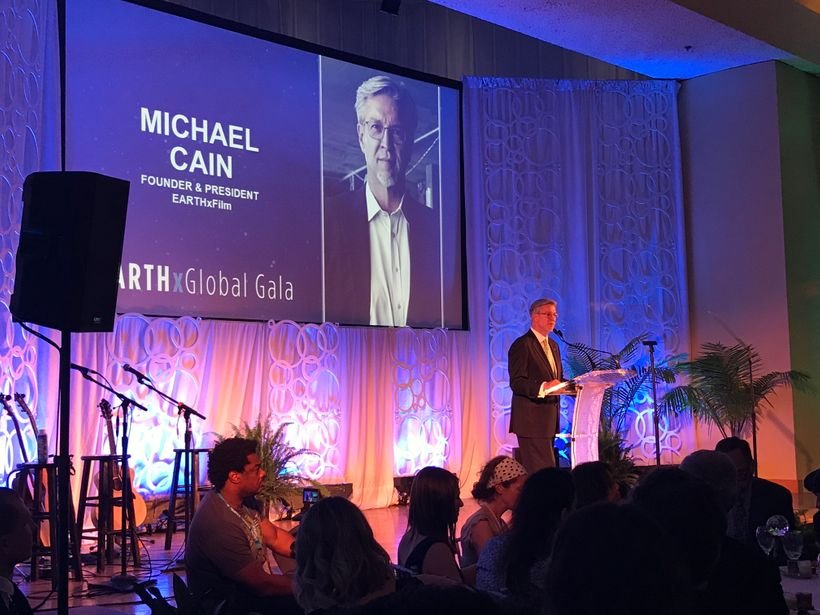
“It’s about different parties getting in a room that don’t necessarily agree with each other,” according to Michael Cain, President of EARTHxFilm, “No one is excused from the table.”

Crow brought Cain, a Sundance award-winning filmmaker and co-founder of the Dallas International Film Festival, on board a year ago to launch an eco-themed film track to complement the rest of EARTHx. Topics this year ranging from climate change to conservation, plasticity, oceans, clean power solutions, GMOs, farming and extinction, comprised this year’s line-up of 23 full length feature films and 33 shorts. There were also filmmaking workshops and Virtual Reality exhibits.

If the theme of “something for everyone” is coming into view, that was in fact the focus. Cain set out to curate films that “connect to the head and heart” on a range of topics that mirror the trans-partisan programming track.

I was able to squeeze in two new movies, each of them equally impactful and well produced. The first was Plastic Ocean, which like Chasing Coral—one I had seen at Sundance in January but was also screened in Dallas—left an impression that haunts me still.

If images of fistfuls of plastic debris being removed from the carcasses of shore birds and fish don’t turn your stomach, you’re not paying attention. Especially, when one considers that plastic does not break down in the atmosphere or the ocean, and marine creatures are increasingly mistaking plastic bits for food as more debris reaches the ocean from streams and runoff. The sight of intact plastic beverage bottles bobbing on the ocean floor for perhaps eternity made me feel physically nauseous. That’s the potential of media done well and a perfect, if upsetting; example of what Cain calls “the power of film to change the world.” It’s a mixed blessing “to know” because plastic is so pervasive. But only when enough people are aware can things change.

The second film I previewed was Happenings, a mostly optimistic documentation of the exploding clean power sector from Jamie Redford—son of Robert—who matches his father when it comes to concern about our environment, but without the Hollywood trappings. The filmmaker takes us on a multi-state voyage as he seeks out examples of energy solutions in the works, from Apple’s clean powered data centers in the desert, to Marin County’s Green Energy option for residents and businesses. At one point in the film the younger Redford’s adolescent daughter is less than thrilled about new solar panels going up on the family’s Marin rooftop. When Jamie asks Lena (Redford) why she’s not more excited, she answers—with typical pre-teen snark—because it’s only one house.” What about everyone else?”

Hers is a good question and again fundamental to the challenges of educating and engaging the masses, to go beyond the margins in America’s greener pockets. The message resurfaces in one of the film’s final scenes when, returning from their green energy road trip, Jamie—at the wheel—appears despondent as they drive along the freeway. When Lena asks her Dad why he was so glum, he answered with the essence of her earlier comment—“Despite the few great examples we saw, what about everyone else?” She attempts to comfort her forlorn father but who among us who care—often caring too much while way too many others appear oblivious—cannot relate? The key to success—if we are to leave our children a healthy environment—is to amplify and scale the solutions, commensurate with the scope of the challenges.

This gets us back to Trammell Crow’s mission: to not let what happens in Dallas stay in Dallas. Instead, attendees are urged to interact with the material, whether it’s seeing a powerful film, hearing a provocative talk, or participating in a “hackathon” that featured 1,200 high school and college students attempting to address real-world environmental challenges in short order. There was also an E-Capital Summit, matching investors with start-up eco-preneurs, and more than 1,700 booths of all kinds. Indeed, there was something for everyone.

One of the highlights for me was the food, which was, decidedly, NOT your typical green event fare. At a fundraiser for forest preservation at a venue on the Fair Park site Saturday evening, “chicken fried lobster” was served and because it was so tasty—and there were a few empty seats at our table—I got seconds, and that’s a first.

Usually at climate and sustainability conferences the fare is much more “P.C.” – vegetarian or maybe organic chicken or “sustainably farmed” salmon is served…certainly not steak and lobster, but no complaints! On the one hand, I can appreciate the argument that such gatherings should serve as a model for sustainable living. On the other hand, the raw vegetable salad and quinoa served at lunch the day before, was a bit on the skimpy side—until I realized that it was just the appetizer when a plate of Texas beef was plopped down in front of a surprised me. I had just finished my delicious vegan lemon dessert because the baby vegetable slices had not quite filled me up. A few bites of the beef were enough but I must confess, it did taste good.

There were two other culinary signs that I was not in San Francisco anymore: 1) there was seemingly no coffee to be found anywhere on the 227-acre fairground sight, unheard of where I come from; and 2) in the media and volunteer center instead of the usual organic fruit and cheese platters, there were bags of BBQ Fritos and chocolate chip “health” bars. There was also a refrigerator filled with chilled soda. Desperate for a caffeine fix I helped myself to what was the first Coca-Cola I’ve had in years.

If it sounds like I’m complaining, I am not. I truly loved the contrast and cognitive dissonance that Crow has created, intentionally or not. For too long I have lamented that when I go to an environmental event–- whether a conference or a film screening— it’s the “usual suspects,” people I know to be active in the climate or sustainability communities. Where is everyone else? Even in my own supposedly progressive Marin County, I often ask myself, “where are the soccer moms, or people from my gym?” Many who comprise what I refer to as “the mainstream” were among the reported crowd of 114,000 this year. For someone who laments the slow spread of environmentalism from the margins to Main Street, it’s encouraging to know—with numbers so supersized—that surely hundreds of attendees who came, learned, watched and discussed what they experienced—will go on to become tomorrow’s “solutionaries.” For a builder like Crow it must be satisfying to know that he is laying a foundation for the next generation of leaders.

My overview of the mega-event would not be complete if I failed to mention the glitz factor, or what I call “Greenerati.” Although neither Leonardo DiCaprio nor Mark Ruffalo have yet made their way to Dallas for the biggest Earth Day Expo in the land, it’s just a matter of time before they do. This year actress Jennifer Beals (Flashdance) accepted an award with Michael Green of the Center for Environmental Health and Laura Turner Seydel (Ted’s daughter, also a committed environmentalist) and her husband Rutherford, walked the Green Carpet.—pictured above with Jessica and Matthew Upchurch. Additionally, there were a handful of eco-luminaries including Sylvia Earle, affectionately known by fans as “Her Deepness,” Captain Paul Watson, founder of Sea Shepherd, and filmmaker Jeff Orlowski of Chasing Ice and soon to be released Chasing Coral fame. Louis Psihoyos, who directed pivotal films, including The Cove and Racing Extinction, also drew a crowd.

In the end, I loved spending my twentieth Earth Day since starting out on the green beat, in Texas. Where else can you find someone at the top who is so worth “crowing” about? And chicken fried lobster? As long as there is an ocean for such delicacies I’m down for that (though at the rate we’re warming our oceans, shellfish may someday be a thing of the past). I’m not pretending this type of food is sustainable, or exemplary, but it IS authentic Texan fare. In a world filled with fake news and alternative facts, I have a new appreciation for things that are real. I can also hold in high regard a strategic desire to appeal to all shades of green, PC or not, Texas style.

In Trammell S. Crow’s own words “they come here as empty sponges and they leave saturated. At least until next year when they come back for more.”

I hope to return as well, along with a few California grown suggestions of my own.

When the “Fair and Balanced” Network Surprises

It was an extraordinary moment one week ago on April 2: Chris Wallace of Fox News—a media entity that has denigrated climate science and climate activism for years—turning up the heat on EPA Administrator Scott Pruitt for the latter’s disavowal of the scientific verdict on climate change.

Obviously, Wallace won’t be joining 350.org anytime soon; the Fox News Sunday host also has a long history of casting doubt on climate science, and pointedly refused to ask any questions about climate change in the third presidential debate between Hillary Clinton and Donald Trump last fall. So why would Wallace hammer away at Pruitt’s rejection of the evidence that the burning of fossil fuels is driving the planet towards climate chaos?

In all likelihood, Wallace felt motivated to press Pruitt on pollution for the same reason that former Secretary of State James Baker felt motivated to urge the Trump administration to support a federal carbon-pricing policy; in both cases, the idea could well be a survival instinct to protect the Republican Party from self-destruction.

Pruitt is arguably the single most controversial figure in the Trump administration; his full-on rejection of the overwhelming data proving that oil, gas and coal threaten the planet as a whole could drive those who are not committed right-wingers away from the Republican Party for good, a problem the GOP absolutely cannot afford. As a loyal, lifelong Republican, Baker has an obvious personal interest in protecting the political health of the GOP; as a Fox News figure, Wallace has an obvious professional interest in protecting the political health of Fox’s preferred party.

According to the Yale Program on Climate Change Communication, “[A]bout half to a majority of Trump voters think global warming is happening and support a variety of climate and clean energy policies…Over half of Trump voters (52%) support eliminating all federal subsidies for the fossil fuel industry, nearly half (48%) support requiring fossil fuel companies to pay a carbon tax and using the money to reduce other taxes by an equal amount, and almost half (48%) support setting strict carbon dioxide emissions limits on existing coal-fired power plants to reduce global warming and improve public health, even if the cost of electricity to consumers and companies would likely increase.” In other words, a significant portion of Trump voters disagree with Pruitt on climate change—and if their concerns about the climate crisis intensify, they may seek alternate political routes.

Baker doesn’t exactly consider himself a climate hawk, and Wallace will never be confused with MSNBC’s climate-conscious Chris Hayes. However, Baker and Wallace clearly understand that the GOP cannot deny the abundant evidence of human-caused climate change in perpetuity, thus risking potentially severe Election Day consequences. One can only wonder when and if Fox’s loudest deny-o-saur, and Trump’s buddy, Sean Hannity will ever wake up and smell the carbon. Given how many times he has spouted outright lies on his program about climate realities—and that’s just the dozen or times I’ve been on his show to spar with him and his climate-denying cronies—it’s impossible to imagine Hannity (or “Inanity” as I call him) ever acknowledging he was wrong. Especially as long as his paycheck, and network’s ratings, depend upon the profits made by perpetuating provocative nonsense. Never mind that the planet’s fate hangs in the balance – let’s mock the tree-huggers at any cost, and denigrate climate scientists too while we’re at it. As if Hannity and Company know more than 97% of experts in their field of focus! But I digress…

The political climate finally appears to be changing in the United States, with a growing number of House Republicans pledging to work with Democrats on climate solutions and major corporations acknowledging the need to curb carbon emissions. If the Trump administration expects to survive politically, it cannot be deaf to the concerns of Republicans who don’t buy into the idea that climate science is a conspiracy concocted by the Chinese government.

It’s not likely that Pruitt will change his tune on climate change anytime soon, but as ecological and political storms gather, it’s not beyond possibility that his time as EPA Administrator will come to an end sooner rather than later. Those who deny the settled science of climate change were thrilled when Pruitt became EPA Administrator, but they may soon find themselves outfoxed by reality.

Rooted In Peace Is Rooted In Hope: A Time for Action

Greg Reitman is indeed the right man to make this sweet and poignant film at just the right time—amidst a current backdrop of political bitterness, unprecedented national divisiveness and bellicose buildup of military might at the expense of public health and our environment.

Although Donald Trump was not yet on the political scene when Rooted In Peace was conceived and produced, his presidency and dark values loom in stark contrast to the movie’s primary message of the need for peace, hope and love to prevail if humans hope to live in harmony with themselves, each other, and nature.

Open minded and open hearted, Reitman shares his journey from a presumably normal New York City boyhood, filled with the usual comic books and video games, to young adulthood during which his travels exposed him to trauma caused by witnessing violence, even if only as a bystander.

The first two life-changing events occurred on foreign territory—witnessing, as a student, bombing raids in Israel during the first Gulf War, and years later during a visit to Hiroshima while surveying the devastation from World War II. The third encounter with violent trauma hit closer to home as we learn in an interview with Reitman’s brother-in-law, who witnessed the 9/11 attacks on the Twin Towers.

Setting out on a journey of self discovery—armed with a miniature “peace tree” and existential questions like how did humans learn to become so violent (since we’re not born that way) and how can we reconnect with our inherently peaceful nature as individuals, nations and a planet—Reitman takes his quest for answers to India and seeks out spiritual gurus like the Maharishi and Deepak Chopra. Along the way he poses philosophical queries such as: Is there any such thing as a just war? And can one be an angry peace activist?

Along the way Reitman comes face to face with…himself. First, in the form of health issues which force the filmmaker to seek medical advice, ultimately leading to a change in diet and exercise habits. Next, he confronts anger issues in his relationship with girlfriend Britta, a co-producer in the film. Once he gets the toxic stuff out of his body and relationships, Reitman turns his lens on the endangered health of our planet. He meets with noted environmental thinkers like Paul Hawken, Lester Brown and William McDonough, who weigh in on what must be done to reverse ecosystem decline and the planetary crises caused by, and facing, mankind.

Throughout the film there are cameo appearances and clips with Desmond Tutu, Pete Seeger, David Lynch and Ted Turner. Also threaded throughout was a killer soundtrack with songs from Mike Love and The Beach Boys, Donovan, Sting, Coldplay, Pink Floyd and David Gray.

In the end Reitman welcomes and shares wisdom gleaned from his worldly mentors. Among the nuggets? A meditation practice can expand the brain to become more receptive than reactive: our hearts have a stronger connection to our emotions than our brains: our planet is the circulatory system of all life: and the rage of Gaia (earth) will come back with great vengeance if we continue to abuse, and take from, nature. And closing the loop back to where the film opens with the mini Bonsai, humans have more in common with trees than it would appear on the surface, including the ability, and necessity, to breathe oxygen.

The movie concludes with a nod to its title. Following many scenes in which the seeker-filmmaker is planting trees, Reitman turns over the omnipresent “peace tree” to his nephew, in whom he seemingly plants his hopes for a better future. Finally, in the ultimate act of hope, we see Reitman and his girlfriend tie the knot while the sun sets on the couple beginning their future as a married couple.

Now if only we could make Rooted In Peace required viewing for everyone, especially those in the Trump administration. In that fantasy scenario Reitman, will have planted seeds of change that would cause a pivot toward peace and sustainability and away from a no-win war on ourselves, each other and our precious planet.


Greg Reitman is a director, producer, writer and active member of the Director’s Guild of America. Described by Movie Maker Magazine as “one of the top ten filmmakers producing content that impacts our world,” he is the founder of Blue Water Entertainment, Inc., an independent production company. DVD release for the film is May 10th, to be sold at Whole Foods nationwide.

My First Sundance: A Bright Ray of Light in a Storm of Darkness

It has only been two weeks since I returned from Sundance and already I can hardly wait until next year, although it’s hard to imagine anything matching the drama and spectacle of SFF 2017. And that’s just from what happened outside the theaters.

At the closing Awards Ceremony Festival Director John Cooper said, “This has been one of the wildest, wackiest and most rewarding in recent memory. From a new government to the independently organized Women’s March on Main, to power outages, a cyber attack and record levels of snow, the work of our artists rose above it all.”

With a surreal Presidential Inauguration and a storm of protests across the country, those back-to-back national events set the stage for the festival’s spirited kickoff at 7,000 feet. Turnout for the Women’s March in Park City was more than twice was what expected when Chelsea Handler announced she would be leading the charge. A handful of notables joined her, including musician John Legend and social activist Dolores Huerta, whose film about her life debuted to rave reviews.

It was my first time attending and armed with a full festival media pass, warm boots and a strong desire to take my mind off what was coming down in Washington, it was an entirely satisfying adventure. The thought provoking documentaries, and attendant events, were the perfect distraction to the show going on in D.C.

It was the debut of the New Climate Program that got me to Sundance. Twenty years of covering green news and views on local, national and Internet radio finally paid off. The lure of seeing Al Gore’s sequel to An Inconvenient Truth six months ahead of its public release was just too tempting to miss, as a climate denier was taking office and filling his cabinet with like-minded appointees. The opportunity to be immersed in environmental films was a welcome diversion from the man with America’s biggest ego, and eco-footprint, moving into the White House.

I was not disappointed. Not only did I get to see An Inconvenient Sequel –Truth to Power as well as Chasing Ice’s sequel, Chasing Coral, also about the effects of climate change, I was also able to hear Al Gore, Robert Redford, Jeff Skoll, David Suzuki and President Mohamed Nasheed, formerly of the sinking Maldives, in a timely panel discussion. (Speaking of presidents, I almost got to see Malia Obama, missing her and a girlfriend in a consignment store by only five minutes. Can you imagine Ivanka buying second hand? Neither can I.)

The March was also a highlight. An estimated 8,000 strong — women, men and children — braved a snowstorm, many in bright pink hats, carrying signs that ranged from clever to crude (but still clever). We marched, or rather trudged, in the wind and snow, holding hands to keep each other, and our cell phones, from freezing. As a longtime environmental journalist, Trump’s election hit hard since he appears fixated on inflicting lethal blows to both the planet and the Press. As was the case for millions of others, this mass revolt against the bombastic billionaire — repeated across the country and world — reignited my hope, activism and spirit. It’s a good thing because most of the films I watched were a downer, but like Trump has done, they also got me fired up.

Many of the films moved me because they were substantive, well made, timely and troubling, if not downright terrifying. In the terrifying category, Chasing Coral was a stunner, both visually and for what it portends. Director Jeff Orlowski has done for coral reefs what he did for Arctic glaciers five years earlier; captured on camera through time-lapse photography their demise. Bringing the sobering reality of rapid planetary change that’s occurring “out there” to the big screen “right here” hits home, hits hard and is impossible to dismiss once you’ve witnessed it.

I cannot forget seeing the video of an older woman, a self-proclaimed “die-hard Fox Bill O’Reilly fan” leaving the theatre in tears after viewing Chasing Ice. The woman told an interviewer that she’d come to “laugh about global warming” but now that she’d seen it with her own eyes, was intent on letting everyone she’d previously argued with about climate change know of her pivot in opinion. She vowed to tell friends she was wrong and very sorry “for kicking them out of her house.” That’s the power of media done well and I’d love to track her down for an update! The link can be found here: https://youtu.be/S9xVS9bXMFc

Watching the transformation of coral reefs was equally dramatic. During a three year period the film was colorful, pulsating live organisms morphed into tangled brown carcasses. This is due primarily to warming ocean temperatures at a rate that is both dizzying and sickening. Orlowski and his intrepid crew visited several continents to bear witness to the destruction offshore and to share with the world what it means for our future. An estimated one-quarter of all sea life feed on coral reefs, the underwater canary. During the festival it was announced that Netflix picked up worldwide rights to distribute Chasing Coral, which hopefully will mean millions get to see this alarming wake-up call. It also won an Audience Award in the U.S. Documentary category.

Al Gore’s newly produced An Inconvenient Sequel — Truth to Power premiered on the Festival’s opening night to much fanfare and a few standing ovations with Gore on hand for a Q & A. The film focused on the rapid rise of renewable energy and lowering of costs to help propel growth, especially in the solar sector. But it also showed evidence of mounting threats like rising sea levels, with Miami streets under several feet of water, as well as cause for rising political concern.

Gore’s sequel, like the original 11 years earlier, was part lecture, part travelogue, and part personal journey. The man who would be President is still using some old lines, with references to a “nature hike through the Book of Revelations.” But thankfully, especially for those of us who have spent days with him in his climate training, he also had some chuckle-worthy fresh lines.

Producers Jon Shenk and Bonni Cohen worked with Participant Media to make the sequel, which has now been picked up by Paramount for distribution this summer. Disappointing that we have to wait until July for what will hopefully be another cinematic game changer. At the least It should provide a much needed reality check against the deny-osphere in D.C.

The film included cuts of Trump uttering ridiculous comments about climate change, signaling a dark period ahead. That is unless Al Gore, Elon Musk, Rex Tillerson, or someone can get to Trump before too many of Obama’s hard fought victories are reversed. It says a lot that Tillerson, former head of ExxonMobil — the company that covered up climate data for decades — is the bright spot in Trump’s “basket of deplorables.” That is because he has expressed openness to a revenue-neutral carbon tax, which scientists (and some prominent Republicans, such as former Secretary of State James Baker and George Schultz agree is our best, perhaps only, real hope to avoid carbon catastrophe and climate collapse.

Additional offerings in the new environmental track included Plastic China, Trophy and Water and Power – A California Heist.

Plastic China was a heartbreaker, zooming in on a poor Chinese family forced to make a living picking plastic debris (some from American brands) out of the adjacent landfill to melt down for the Chinese-equivalent of pennies. The father was suffering health problems as a result, and his children didn’t know any other reality, including school.

Trophy, an excellent film by Shaul Schwarz and Christina Clusiau, focused its lens on the sport of big game hunting and the all too lucrative business of poaching. Although it did an excellent job of connecting the dots to extinction threats for species like rhinos and elephants, it also provided a balanced and plausible analysis; the competing interests of natives trying to make a living against conservationists working to save endangered animals. In the case of one South African man, that means using his personal resources to protect rhinos by capturing and breeding them. John Hume prevents them from being killed by cutting off and selling their tusks allowing them to survive, though perhaps not thrive. Hume, advancing in age and a bit battle weary, worries that “his rhinos” will perish after he dies. On the day of Trophy’s World Premiere, The Orchard and CNN Films picked up North American and television rights to distribute the movie. That is encouraging when you consider what CNN’s repeat airings of Blackfish did to rally public outrage against Sea World which ultimately led to a phase-out ban on keeping Orcas in captivity.

The final film I screened in the environmental category was Marina Zenovich’s Water and Power: A California Heist. The producers follow the trail and plumb the depths of water wars in scenes reminiscent of Chinatown. This movie is about a real life crisis and shows the impacts on local citizens who suffer through shortages during drought years while private interests profit by manipulating the law. Imagine my chagrin to learn that the Wonderful Company, which makes my favorite pomegranate beverage, is one of the brands benefitting. Locals are forced to drink bottled water and travel to take a shower while paying five dollars for the “privilege.” Not so Wonderful though California’s current deluge eased some of my guilt.

Perhaps the best news…Sundance Board Chair, Pat Mitchell, announced at the “Artist At A Table” dinner on opening night that the Institute plans to continue A New Climate next year. With the current administration taking aim at the EPA, environmental regulations and global climate agreements not boding well for our planet — at least their regressive actions should yield a bumper crop of compelling new films!

What struck me while at Sundance, and left a lasting impression, was how ebullient everyone was to be there. I guess that’s what happens when you mix 40-thousand film fanatics, creative artists, movie-makers and wanna be’s in snow globe of a town. For political progressives, this Rocky Mountain High surrounded by a sea of misery provided welcome refuge.

In the end, attending Sundance 2017 was a guilty pleasure, getting to see a film at 9:00 am on a weekday in a dark screening room and going late into the evening with screenings, sponsor receptions and media parties. But I came to the conclusion that it’s a worthy pursuit to immerse oneself in thoughtful documentaries around the clock for a week, as social change is needed now more than ever.

Oh how I savored being in that Sundance bubble, hiding out in dark theatres knowing soon enough I’d be back to the new reality of shock and awe. But first please pass the popcorn.

August May Go Down As the Month We Woke Up to Smell the Carbon

Our climate is changing. The impacts on our weather, food and water supplies, oceans, forests, public health, national security and economy are already being felt. Bees and other species are disappearing. These trends do not bode well for humans.

Those facts are not news, or at least not new, but President Obama has made news by making August a Green Letter month taking his newly urgent warnings about our climate crisis on the road. Last stop, Ground Zero, Arctic Alaska where icebergs are melting at a new glacial speed. He will be the first sitting President to bear witness to “the challenge of our time.” Hats off to him and it just might be warm enough.

Perhaps after this record breaking hot summer we will set a new normal for climate change coverage as well. To date, we have not seen a majority of serious environmental developments covered regularly and with sufficient context and depth on the evening news or on any recurring talk shows. It’s time for the news networks to step up their game.

For too long we have had what I call a “Glaring Green Gap.” Our eco-systems are in decline — nearly across the board — and our addiction to fossil fuels is our culture’s dirty not-so-little secret. Outside green circles it has not been part of our national conversation nor a regular part of the media mix. Too few Americans are aware that we are in the midst of a sixth mass extinction, the first caused by humans, and that our seas are under siege due to warming waters, overfishing, “dead zones” and plastic pollution.

While newspapers are doing a better job of going deeper into these issues people are often surprised to learn there are precisely zero talk shows on commercial broadcast stations dedicated to covering our changing environment and discussing what we can do about it. I cannot think of a better use of mass media outlets during this time of crisis especially with timing so critical.

After creating, producing and hosting three popular Green programs: “Trash Talk” on KCBS Radio in San Francisco, “Eco Talk” on Air America — a daily talk show with 50,000 listeners per night back in 2006 — and “Green Front” airing on the internet, I learned there’s a growing audience hungry for this new program genre. Nearly a decade later the multitude of challenges and solutions have expanded exponentially and yet mainstream media has not yet filled the green gap with dedicated content.

A big part of the problem is network gatekeepers, both at the programming and executive levels. They are trained to go with the tried and true which often means playing to the lowest common denominator. Just look at the plethora of so-called reality shows while we ignore eco-realities and our future hangs in the balance!

Additionally, program managers I’ve communicated with over the years assume such content would be “too controversial or too political.” However, with fossil-fuel interests leading, and funding, “the deny-o-sphere,” isn’t it time to stop emphasizing the special interest fear-based aspects and wake up to the practical realities of these shared threats?

In addition to the green programming gap on a national channel, there is no formal education or consistent outreach being offered to citizens and communities. How are average Americans supposed to know what they can do to better understand our changing ecological systems, have a more positive impact and lighter footprint on our life support systems, both for nature’s sake and our own?

If not in mainstream media, what about academia? Sustainable solutions are being discussed on campuses across America in ecology clubs, Environmental Studies programs, and a few new Green MBA programs, but does that mean we should wait until the next generation comes of age armed with enough understanding to start digging out? If we do too little today their task will be that much larger tomorrow. There isn’t enough time to turn over the shovel to Gen X, Y, or my daughter’s Millennial generation, forcing them to clean up an even bigger mess later.
By ignoring the need to educate and engage Americans who have long since left the classroom, we are missing an opportunity — and obligation — to have all able-bodied citizens do their part.

So who is talking about what we can do on channels that reach the masses?
Evidently, at least up until now, mainstream newspaper publishers and broadcast news editors have not seen it as their role or responsibility to offer eco-solutions.

When Paul Rogers, an executive at the San Jose Mercury News, was questioned at a 2013 San Francisco Commonwealth Club panel about why his newspaper didn’t offer more coverage on climate change solutions, he replied that it was the job of Greenpeace, the Sierra Club and other environmental NGOs, not the news media to inform on what steps people can take.

While grass roots groups representing various green causes do their best to get media attention to cover these matters the news media powers-that-be assume it’s up to the grassroots to get word out, if not to do the actual environmental clean-up needed.

Therein lies the Catch-22 of just who is responsible for educating the public on climate and conservation tips?

Meantime, with a handful of notable exceptions, corporate America doesn’t see it as their obligation to accelerate eco-innovation or talk about valuing sustainability in their marketing.
What about the federal government? I’ve often wondered why the EPA doesn’t do substantive public outreach. How can we, as citizens, protect our environment if no one is telling us what to do or why it matters? The information is out there yes, but it has to be easily accessible and omnipresent in order to penetrate the zeitgeist.

It is essential to establish mechanisms and media channels to bring average citizens into the conversation about conservation, and with all the breadth and depth needed to make rapid societal shifts.

Failure to connect the dots between extreme weather events and climate disruption is a failure of leadership on the part of government, corporate America and my professional arena, major news media.

It will be interesting to see how the news networks cover President Obama’s trip to the Arctic this week. I suspect they will get on board this big media opportunity. However, just in case, perhaps Kim Kardashian should go along to ensure maximum exposure. Or maybe someone should send the omnipresent Donald Trump? Then again, no — all his hot air may hasten the melting of Alaska’s glaciers.

POTUS and Climate Change: Four Steps Forward, One Step Back, but Still Missing a KEY Step

Barack Obama is about to leave on a historic journey that could affect Americans for generations to come – he’ll become the first sitting American President to visit the Arctic to observe Alaska’s rapidly melting glaciers. This trip, coming on the heels of Obama’s historic clean energy plan is groundbreaking. Also poignant as it will coincide with the ten-year anniversary of Hurricane Katrina which signaled the arrival of climate change on U.S. shores— whether Louisiana Governor Bobby Jindal wants the president to talk about it in New Orleans or not.

On August 13th, our Commander-in-Chief took time out from his vacation to announce the Arctic trip, declaring, “What’s happening in Alaska isn’t just a preview of what will happen to the rest of us if we don’t take action. It’s our wake-up call — the alarm bells are ringing. And as long as I’m President, America will lead the world to meet this threat before it’s too late.”

The Obama administration’s Council on Environmental Quality even hosted a panel discussion on August 20th about what’s being done on college campuses to educate youth about the climate crisis. This is a step in a very positive direction. However the president can’t get an “A” in my book until his administration does something to address the eco-education gap among adults.

This week President Obama addressed the Clean Energy Summit in Las Vegas. He sounded like a true advocate in declaring, “Solar isn’t just for the green crowd anymore—it’s for the green eyeshade crowd, too!” in praising recent cost reductions for renewable energy.

However, Obama’s decision, announced last week, to grant Shell Oil the rights to drill in the Arctic seemed to fly in the face of his earlier news and left climate activists scratching their heads. Is the Obama administration trying to pull a fast one —a Shell game— or what? That’s not yet clear, and the timing is particularly puzzling since his drilling decision so closely precedes the fact-finding, glacier-gazing trip to Alaska.

Given the latest data showing Greenland’s glaciers melting at a dizzying rate of three feet per hour, this journey comes none too soon. Not to mention that July was the hottest month EVER recorded and 2015 is set to melt records.

Yet the green light given to Shell, especially after the oil giant botched its first attempts to drill in the pristine region, seems oddly timed. What is clear is it’s too soon to uncork the champagne in celebration. Better keep it on ice until after Obama sees the melting icebergs, drills down, and connects some more green dots.

I put some bubbly in the fridge to chill after the President’s August 3rd Clean Power Plan announcement. Comments like “…no challenge poses a greater threat to our future and future generations than a changing climate,” “There is such a thing as being too late when it comes to climate change,” and “We only get one home, one planet,” and “There’s no plan B” showed that Obama understands the importance of this crisis, and also its immediacy.

What rocked my world most about Obama’s announcement was that CNN carried it live. Millions around the country and world got the full impact in real time – similar to the Pope’s pivotal encyclical on climate change. Getting the mainstream news to report on growing threats from a changing climate and other eco-existential challenges is paramount. It’s been a commitment of mine for more than a decade to bring this to fruition.

As a former CBS Radio reporter and anchor who left breaking news to cover our breaking planet and emerging eco-evolution as an independent radio host/producer, I can attest to the fact that there is zero programming on any commercial broadcast network – radio OR television – that covers these critical environmental changes.

I call this astonishing media void the “glaring green gap” and have been trying to fill it for more than a decade. After producing and hosting more than 2,500 shows on the former Air America network (left of center) between 2004-2007 and later independently on the internet, archived at www.thegreenfront.com and www.ecotalkradio.com, I have experienced first hand how much there is to learn and report on, both in terms of challenges…and solutions.

There are at least “50 Shades of Green” both in range of topics (from garbage to GMO’s to global warming) and “E”-list guests. Eco-leaders like Al Gore, Robert Kennedy Jr., Van Jones, climate scientists including Dr. Jim Hansen and Dr. Katherine Hayhoe, writers Francis Moore Lappe and Elizabeth Kolbert, and Senators John Kerry, Barbara Boxer, Bernie Sanders have all been interviewed on my programs, but they represent just a tip of the melting iceberg when it comes to credible and compelling voices for our embattled environment. Passionate experts on these topics must be heard by the masses in order to broaden our understanding, widen the conversation and prompt restorative action.

It’s worth noting that not one of the questioners or candidates in the August 6 Fox News Channel “prime-time” GOP presidential debate mentioned the climate crisis, energy or the environment, other than Jeb Bush taking a jab at opponents to the Keystone pipeline. And just ahead of the President’s visit to New Orleans Thursday Louisiana Governor Bobby Jindal warned against linking Katrina to climate change.

Keep in mind that Jeb Bush’s low-lying State of Florida is predicted to be the first U.S. casualty of rising sea levels. No one who watched the debate heard any discussion about the need to scale back our carbon emissions to 350 parts per million.

Just imagine how many millions would get a critical education and quick wake-up call on our shared eco-reality if the TLC network replaced its cancelled hit reality show “19 Kids and Counting” with a program called “400 Parts Per Million and Rising.” Now that might get America to wake up and smell the carbon!

After all the Accolades Some Inconvenient, Inexplicable and Inexcusable Truths Still Remain

betsyandalgore
Al Gore’s pivotal film, An Inconvenient Truth (AIT), put climate change on the world map, and got many Americans thinking, and talking, about this worsening existential threat. There has been real progress with much of it coming in late 2015, including President Obama’s executive actions, Pope Francis’ encyclical Laudato Si and the pivotal Paris Agreement. Last week’s tributes to Gore and the film’s producers were welcome and deserved. Some of us who had been concerned, and communicating about global warming for years prior, thought AIT would change everything. It didn’t.
A decade later there remain glaring gaps that are key to wider public acceptance and much needed mass action. What’s still missing comprises a long list, but at the top I put a lack of credible information and inspiration, programming aimed at the general public coming from mainstream news outlets, both broadcast and cable, and on the television and radio networks. There’s a sustainability revolution underway but you’d never know it if you just get your news from the networks only. It’s far bigger than the information or tech revolution for this one will determine our collective fate.
While world leaders, government agencies, insurance companies and corporate America have begun to take the threat(s) seriously, national news outlets are still (with a few exceptions) ignoring the biggest story of our time—what’s happening to nature, our life support system—at our own hands. Inexplicably, none of the news networks are offering any programming to educate the public, nor providing a national forum for discussing solutions about what citizens and communities can do to have a positive impact. News executives do not see this as their responsibility and assume few care enough to tune in. They also don’t know what they don’t know.
I believe they are wrong on both counts but trying to convince program executives of that, let alone get a meeting, has been a frustrating focus of mine, going back even before Gore’s film came out. In fact his was among the networks we pitched when he and Joel Hyatt owned Current TV! Gore was on my radio show when An Inconvenient Truth debuted and I’ve been trained by him, as part of his Climate Reality Project, so he knows that I’m qualified. Gore turning down a ready-to-go show on climate change while lambasting mainstream media for ignoring the issue was a little more than inconvenient – I have filed that one under “Inexplicable”.
In an anniversary interview last month Gore repeated his still apt line about how weather reports are starting to sound like The Book of Revelations. And it’s only getting worse. Last week southeastern Texas experienced its second “1 in 500 year flood” with nine lives lost. At last report fires were still burning in Canada’s tar sands territory and India melted a new high temperature record of 124 degrees Fahrenheit. Parts of Sri Lanka were under 8 feet of water and nearly 25-million Americans were in the path of severe storms carrying Wizard of Oz-like “monster tornados” touching down in Kansas and Nebraska. Weather conditions in Minneapolis were so severe that crowds at Beyonce’s concert had to evacuate the stadium. As Dorothy might say if she dropped in today, “Tornados, fires, and floods, Oh My”!
News anchors, reporters and weather people are, for the most part neglecting to connect the dots, even if only tentatively. So the public remains indifferent and the beat goes on. As well as the heat. As I write this hundreds of residents in the north of L.A. community of Calabasas are being evacuated as a 200 acre fire spreads in near 100 degree weather
Also missing in action is any meaningful discussion about the climate crisis during yet another presidential cycle. In the primary debate season moderators failed to ask substantive questions about the candidates’ plans to tackle climate change. When they did throw in a fleeting mention, there was no grilling of dismissive Republicans who dare still call it “a hoax,” including the apparent nominee, Donald Trump, who is by his own accounts “not a great believer.” That, while Trump petitions to build a seawall to protect his latest acquisition, a golf course in Ireland. Thanks to Bernie Sanders—who has long been a climate champion in the Senate—the topic has at least been raised, prompting Hillary Clinton to mention her clean energy plans more often on the campaign trail and to come out against the Keystone XL project. Continuing the climate silence giving short shrift to a phenomenon that is already altering life on earth, as we’ve known it, for yet another election cycle, is truly inexcusable.
As another climate champion in the Senate, Sheldon Whitehouse, said in a recent Time to Wake Up Senate speech, “We are sleepwalking through history as carbon piles up in the atmosphere…sitting on our hands acting helpless.” I would add that we are acting like clueless zombies and our culture is complicit in making that okay.
The persistent sad fact is that there is no government or media entity offering citizens and communities advice on how to reduce emissions and help reverse other troubling eco-trends. Of course there is plenty of information on the worldwide web and available through membership in environmental organizations like the Sierra Club and NRDC. But that requires becoming a member or actively seeking out material, which primarily is done by the already eco-aware. Why not make the best thinking on the part of experts more widely available and easily accessible? Given the scope and urgency of these multiple and overlapping crises, it is inexplicable that we are not seeing more mainstream programming focused on exploring the issues, discussing options for what’s needed to scale up.
What are we waiting for, all of Greenland to melt? Until it IS too late to stop runaway climate destruction? Or until—perish the thought—we have a climate “disbeliever” in the White House, someone who likely has the heaviest per capita eco-footprint in the world with all of his buildings, boats, golf courses and planes? Not to mention hot air.

Happy Earth Day America – Time to Get Off Our Gasses!

ED2016-1

As I write this on the eve of the 46th anniversary of the first Earth Day, held on April 22nd, 1970, a “500 year flood” in Houston has already destroyed 1,000 homes and taken at least eight lives. In the television video of people wading through waist deep water appearing in the same moment to be both grateful to be alive and stunned by the devastation surrounding them, I’m reminded of scenes from a film I saw last night about the effects of climate change around the world, including victims from Hurricane Sandy. And yet here it is again, playing out like some slow motion disaster movie. Once again, it appears the homes destroyed were primarily those inhabited by the less fortunate, perhaps in structures built long ago or lacking adequate maintenance.

Even as I’m flying home to San Francisco from a week in New York, watching CNN, the coverage of election news and Texas flooding has been bumped, due to the sudden death of Prince. Of course “breaking news” always “trumps” everything else, and perhaps as it should be. But already into hour four of Prince coverage and the human toll in Texas has been sidelined. And tomorrow is Earth Day. Yet if past years are any indication there will be little, if token, coverage on this one day of the year when Americans are supposed to pay attention to our environment, at least in theory.

Being among the climate obsessed, the plight of our imperiled planet is never far from my mind. In fact I saw two excellent shows on the topic of global warming, now called by most, more accurately, climate change, this past week.

First the Rap Guide to Climate Chaos with the brilliant BaBa Brinkman. The fast talking rapper was on stage for 90 rousing, riffing minutes on the biggest existential challenge of our time. Like Al Gore ten years prior, Brinkman uses slides showing devastation and scary scientific graphs to back up his words with urgency and frightening poignancy.

But Brinkman, who happens to be Canadian, does not leave his audience depressed, at least not anymore so then what’s appropriate. He devotes at least the last third of his emotional roller coaster of a show to the solutions side, the what can we do about it part, though he even has some fun poking fun at himself jetting around the world to perform his one man show about what our gasses are doing to the climate.

And I myself am on a spanking new Virgin Airways jet spewing emissions as people movers always do, so we’re all clearly part of this system whether we like it or not.

Never mind that I was in New York pitching a few news networks, including CNN, on the concept of a dedicated program focused on our environmental challenges and solutions, with a heavy focus on the urgent climate crisis. Maybe a little “guilt offset” if not a carbon offset for my cross-country travels.

But back to Brinkman, who devoted 15 minutes to audience Q and A with an expert called onstage to answer inquiries, on that evening it was a science professor from nearby Columbia University. If you’re in the NYC area this Earth Day weekend I urge you to see it!

Then last night, exactly ten years after attending a screening of An Inconvenient Truth with Al Gore doing Q and A after that pivotal film, I watched an equally well- done movie about the impacts of climate change, this time with Josh Fox. The director of Gasland and Gasland 2, which famously depicted water catching fire as it came out of faucet in fracking country, where Josh grew up. He, along with actor “fractivist” Mark Ruffalo, have helped put the controversial gas extraction process on the map.

After the screening Fox, flanked by his production team on stage, took questions from the audience. In his responses he explained that the Gasland films inevitably pointed to the need to take on the larger climate crisis and so his intrepid crew and camera set out on a voyage to “hot spots” around the world.

He doesn’t just share the devastation; from strip mining to oil spills in the Amazon rainforest, to gas mask wearing children in smog choked Beijing whose residents monitor daily pollution levels and plan their daily activity around it, like we check the weather.

In fact there’s a parallel theme reflected in the film’s title – How To Let Go of the World and Love What Climate Can’t Change – of how a warming world is also a potential unifying force, a common enemy community builder unlike any other. He takes us to villages where there is no electricity and shows what the introduction of solar lamps can do for students who can further their education by being able to study in evening hours. He takes us to Zambia where villagers have neither running water nor electricity. And to the sinking island of Vanuatu whose inhabitants feel “rich” because the 100,000-plus acres they live on provides everything they need to stay alive. But they also show how the natives need each other to survive and how — whether step dancing in unison or sharing tribal stories with wisdom passed down through generations – they have a deep sense of place, tradition and belonging, coincidentally the same qualities lacking in many modern cultures, like ours, where–despite all of our stuff– many Americans feel empty, alienated and lacking purpose.

To his credit Fox does not glorify a more austere past or more primitive cultures, but rather juxtaposes the atmospheric fallout from “developed nations” with the cultures who have “developed their spiritual sides,” but still often the very same people most adversely affected by destructive storms and rising seas.

The movie uses music as a thread throughout, opening with Fox dancing in his living room over a fracking victory and concluding with a gorgeous original song with poignant visuals of two young girls doing ballet on the beach where their Long Island community was devastated by Hurricane Sandy in 2012. The girls, who became close friends after their families met by helping each other in the chaotic aftermath of the killer storm, were present at the screening, adding an extra note of poignancy.

In the beginning of the film climate activist and author Bill McKibben is among the experts interviewed by Fox. They are having a conversation in a Capitol Hill food court with more lights blazing than a Vegas casino. Before finishing they’re asked to leave by a security guard who declares the eating area closed (so why are there enough lights burning overhead to heat the room?) McKibben looks into the camera and dramatically utters words I’ve heard him say before but bare repeating; “we are living on a changed planet,” an Earth so different that McKibben named his 2010 book Eaarth, deliberately misspelled to reflect a new home with an unknown future.

An hour into my flight we learned, via sky TV and CNN, that Prince had died suddenly this morning. When we landed in San Francisco the coverage was still wall to wall Prince and likely will be tonight and throughout much of tomorrow, Earth Day. No slight against Prince, who clearly was a gifted musical genius, and it’s always shocking when someone dies “young,” but in the end how many people does that development, sad as it may be, truly impact? Five hours into the non-stop coverage Prince is still dead and more than 1,000 lives have been forever changed in Houston. And the rain continues to fall in Texas (but no it’s not Purple).

And the planet formerly known as Earth continues to die a little more each day whether or not CNN– and the other big news outlets– cover it, connect the dots, or even consider offering dedicated coverage on what we’re going to do about this crisis.

So I ask where I began this essay, isn’t it time that we begin to get off our gasses?

Or at least start a national conversation on a major news network about how we’re going to do that? There will always be “breaking news” that bumps a breaking climate we need dedicated programming, “appointment TV” as they call it in the biz, where you can tune in at a certain time, preferably daily, and get all your questions and concerns about our planetary pickle(s) addressed by experts in their field who are not only knowledgeable, but passionate and gifted communicators.

And if you don’t have any questions or concerns about our changing environment, how it’s affecting humans, animals and nature–and what we can do about it–then you haven’t been paying attention. And if, as a society, we continue to focus on the sensational rather than the scientific, well then perhaps we deserve what’s coming. Because we have a choice and the television news networks have a choice. To be responsible adults and face our challenges or turn away and “face the music.”

Of course we will miss Prince’s unique brand of music, and activism, but his legacy will live on with his songs and wide influence. Friday is Earth Day and we should spend at least a few minutes pondering the ecological legacy we are leaving our children. And consider letting your favorite TV networks know you’d like them to include news about our breaking planet in the daily mix, including ideas for a fix.

The Climate March Will Break Records But Will It Encourage More Environmental Media Coverage?

As someone who has spent too many years trying to break through what I call “The Green Ceiling” in mainstream media — a steadfast wall of refusal on the part of programming executives to dedicate regular airtime to the then-emerging (and now fully arrived) environmental crises, I am committed to putting that question to a final test next week in New York.

It’s time to disrupt the media status quo on climate silence, connect the green weather dots and invite the rest of America to join the conversation about what we’re going to do to save this embattled habitat of ours, our life support system that makes life — and a life worth living — possible. 

There’s a green buzz in the air, literally, all around me. I’m writing this on a flight from San Francisco to New York City a few days ahead of the People’s Climate March, and already I’ve recognized several familiar faces from home and overheard two conversations by attendees. I’m sure there are other marchers on board as well. Tens of thousands of climate activists are streaming into the Big Apple to make their presence felt and pre-rally activities are already under way. It occurs to me that on this flight, perhaps for the first time, I may not be the only passenger to keep her Styrofoam coffee cup for reuse later. Oh joy!

Sunday’s weather forecast is calling for an unseasonably warm 82 degrees, and that may even be a high for a September 21st. Appropriate given the cause — Mother Nature may be on our side after all! Recall the sweltering late-June day in D.C. last year when President Obama gave his strongest speech yet on the climate crisis. As he repeatedly mopped his dripping brow, the prospect of a globally warmed world did not seem far off at all.

It will be exhilarating to march for climate action with fellow advocates in the city I more commonly associate with Broadway shows and a glut of great gluten-heavy restaurants —including our old family favorite, Carnegie Deli. But that was in the good ‘ole days when we gleefully ate pastrami, and (rye) bread. Now we can enjoy the New York pickles and spicy mustard but hold everything else! Even the world’s best bagels, which we still can’t get in California, are verboten now. Oy vey.

But I digress…it won’t be food or fashion on my mind for this visit to the suddenly Greener Apple. Instead, it’ll be fuel, and what the burning of fossil fuels is doing to our atmosphere. With CO2 levels now topping 400 ppm, we are careening toward a new climate era that has already given us some scary sneak previews.

The People’s Climate March and the UN Climate Summit come two years after Superstorm Sandy brought mayhem to Manhattan and environs. Between that landscape-altering storm and today, record-breaking tornados, wildfires, flash flooding and the California drought have brought about what scientists say is “a new normal.” But while everyone is talking about the extreme weather, what are we doing about it?

That of course is what this rally is all about. Timed to coincide with the United Nations Climate meeting, and to make our presence, and impatience — felt, concerned citizens from across the country are convening to pressure U.N. conveners to take strong and decisive actions, the glaring lack of which turned Hopenhagen into Nopenhagen in Denmark two years ago.

There are an estimated 1,400 environmental, social and economic justice groups of all green shades and stripes, each providing a square of the patchwork quilt that, stitched together, will help us to sew…or see…our way out of this critical mess.

Before, during and after Sunday’s rally, green gurus, groups and groupies will be buzzing around town painting signs, participating in meetings, attending lectures and hopefully raising a ruckus to be seen and heard from Wall Street to Washington Heights. My highest hope is that we’ll also be recognized in Manhattan’s Midtown area, where the nation’s broadcast and cable networks are based.

We’re past the point where major TV and radio stations would dare to overlook the hard-to-miss mass of humanity in their midst. Even with the most conservative attendance estimates, this historic event will be difficult to ignore. I hope I’m wrong, but if past coverage is any indication, CNN, ABC, CBS, NBC, and to a lesser degree, MSNBC, will do VO (voice-over) and B-roll (videotape) on the mega-rally, not in-depth interviews. However this time could be different, simply due to the sheer volume — both in numbers and decibel levels — of this movement-making march.

The big networks may well feel obligated to do more, which I predict will be an interview with the King of Climate Change, Al Gore, the newest eco-celebrity and “fractivist” Mark Ruffalo, (I mean that in a GOOD way—Ruffalo “rocks”!) and the movement’s most thoughtful and understated rabble rouser, Bill McKibben.

CNN also employs the dashing Philippe Cousteau for occasional ocean and climate segments, so I expect he’ll offer insightful commentary. In fact, the Cousteau clan seems to be filled with intelligent, camera-ready commentators, complete with the kind of name recognition that programmers believe is appealing to mainstream audiences (nothing wrong with that approach, but I know for a fact there are MANY more of that articulate green ilk, having interviewed hundreds of passionate environmental experts, activists and eco-innovators over the past decade).

What I am advocating for — and I welcome more eco-collaborators! — is at least one of the major television and/or radio networks to launch a green-themed talk show that highlights the avalanche of environmental changes afoot both in terms of challenges and solutions — already underway.

Given the current media landscape — with hundreds of networks if you include cable TV and satellite radio, and thousands of programs available (many of questionable, if not laughable, merit) — the continuing fact that there is NO dedicated programming on our “eco-evolution” anywhere on commercial outlets is appalling, and should not be allowed to continue. (Shout out here to Living On Earth, NPR’s long-running stalwart show on sustainability.

I love it, and listen every week, but the Americans who most need to have their eco-literacy levels raised are not the ones tuning in). But what it will take, and what I’ll be knocking on big lettered doors (CNN, CNN Headline News, ABC, CBS, NBC, MSNBC) hoping to pitch, is a lively, empowering informative and inspirational interview format program that addresses the mountain of interconnected eco-crises and what leaders across the green front lines are saying and doing to turn the Mother ship around.

Because if not now, when? Programmers, and to a large extent the public, don’t know what they don’t know. If we can engage a critical mass of citizens outside the choir — before the compounding damage to climate, oceans, forests, species and everything else under our power generating sun, is beyond the point of no return — than we’ll really have something to celebrate next Earth Day, the 45th anniversary of the moment Americans first tuned into their environment en masse.

So wish me luck and stay tuned. If we can get more Americans to join the conversation about a brighter green future, then we will ALL benefit, especially our children and theirs. When you stop to think about it, how can we afford NOT to make this happen? As Bill McKibben said on my program a decade ago, in the end it’s a question we each have to answer ourselves: “How DO we love our kids, country and planet?” Now stop reading, put down your laptop, and come march with us into the next chapter of America’s energy future.

What You Can Do to Honor Robin Williams’ Life and Legacy

The death of Robin Williams one month ago hit close to home. I can see his bayside neighborhood from my back deck in Marin, the county where America’s most beloved funnyman grew up, showed up, lived, loved and died. He is still being mourned, the power lines brought down by the giant media trucks are still being repaired, and his shuttered house a sad reminder of what happened inside. But happier memories are still being shared now that the shock is subsiding, somewhat.

Like many local residents, I had my own encounters with the man I first experienced as Mork on our family’s TV set in the ‘70s.

I first met Robin Williams on the set of a film my newborn daughter was in as a baby extra. While Nine Months (1995) was not one of William’s major acting roles, it was a big deal when my girlfriend — also a new mother — and I bumped into him in the elevator during a filming break. I still have the photo of him dressed in doctor’s scrubs holding my Jenna as if she were his own. Years later, when we met again at a fundraiser, I jokingly showed him the picture and asked why he had never written or called. My infant daughter is smiling brightly, “almost a laugh” as she peers up at Robin adoringly.

Living in the same area as Williams and serendipitously having my only child in one of his movies before she was a month old is not really why his suicide touched a familiar nerve or two. Three members of my own family died by suicide, and my father died of complications from Parkinson’s Disease, which the world now knows Williams had also been battling, along with depression.

Twenty years ago, in a house less than a mile from Williams’ residence, my first husband took his life. Forty years ago my mother — beautiful, beloved and with a genius level IQ — took her life. And 20 years prior, the grandmother I am named after but never got to meet, took her life in a hospital room in New York City.

What they all had in common was each suffered from at least one illness that was chronic but not necessarily terminal, combined with biochemical depression. The combination can be deadly.
In my late husband’s case, he had been suffering from the ravaging effects of Multiple Myeloma, a bone marrow cancer, that disfigures by eating away at the marrow and creating brittle bones. Mark was 49 years young.

Jane, the woman who gave me life, had battled Colitis and Ileitis for years before the physical pain associated with simply eating food combined with inherited depression made the suffering unbearable. While she had many happy years raising three kids and being the life of the party, her dark days eventually grew more frequent and debilitating. She was unfortunate enough to have hit her low point just a few years before Prozac was invented, and was given Valium which didn’t help. Jane was only 40 when we lost her which left a gaping hole in my heart, family and life, a traumatic loss that continues to have ripple effects even to this day.

Bertha, my maternal grandmother and namesake, had suffered from Rheumatic Fever which caused heart damage, eventually requiring surgery. But back in the mid-‘50s they reportedly didn’t know about post-operative depression, especially with cardiac cases. She hung herself with hospital bed sheets leaving behind a heartbroken husband and two teenagers.

In March, 2001 my handsome and hilarious father, Jerry, died of complications from Parkinson’s Disease. His was not a suicide, but the circumstances were equally tragic, as he had undergone a fetal tissue transplant to ward off the early symptoms of Parkinson’s. A brain hemorrhage within 24 hours of the experimental surgery left him unable to walk, talk, eat or ever make us laugh again. While Jerry was no Robin Williams, he WAS the funniest guy in our family and his social circles. His dry sense of humor and perfect timing made for showstopping toasts at both my weddings. One of his lines was so clever he made it into the San Francisco Chronicle‘s infamous Herb Caen column.

Six months after we lost our dear Dad, on September 11th we as Americans lost our complacency and sense of safety, along with some 3,000 souls, to terrorism. And my family narrowly missed having another loss that day. If it hadn’t been for an impromptu call and invite from a former girlfriend the night before, my stepson Jon could have died on that beautiful Manhattan morning. He was scheduled to attend a conference at Windows on the World in the North Tower but drank too much the night before and slept through his alarm. Instead Jon was awakened by the sound of a plane crashing into the building from his apartment on nearby Hudson St. Life can be tenuous, death can be random and miracles can happen.

One of my miracles was second husband Alan appearing in my life soon after I became a widow at age 37. And just in time to have the daughter I’d yearned for in part to recreate the bond with my own mother. The baby girl who made her “stage debut” in Nine Months is now a sophomore at NYU.

After becoming a mother I grew weary of my career in radio news covering breaking stories and was increasingly frustrated with what got covered and what didn’t merit attention. I wanted to use my voice and skills to reach the public with content that was more relevant, and less fleeting, than the news du jour. So I “recycled” my career, transitioning from reporter and anchor for CBS Radio to radio-activist, using my broadcast platform and microphone to raise eco-awareness.

Beginning on Earth Day 1997, with “Trash Talk” minutes on KCBS offering tips on how to reduce, reuse and recycle, my waste prevention focus eventually widened from garbage — and all that’s going into our landfills — to global warming and what’s coming out of our tailpipes. My green features went from local radio to a national, hour-long show on the short-lived liberal network, Air America. Heard in more than 40 progressive radio markets, EcoTalk became the first green-themed program to air nationwide on a daily basis. After Air America went bankrupt I moved my show to the internet, continuing to interview sustainability leaders and eco-innovators across the green front lines.

What does all this have to do with Robin Williams? Despite all the publicity around his stunning death — and especially here in Marin County, where so many stories about encounters with this sweet and generous man persist — I’ve yet to hear of one that mentions his concern for our environment.

Many locals know Robin and his wife were big supporters of the arts, education and numerous children’s causes, but little has been said publicly about his interest in climate change. I was at two environmental fundraisers where Robin Williams either performed or emceed. Friends of the Earth was one of the venues. One year he showed up at their annual fundraiser in San Francisco with his buddy, Chevy Chase. Attendees got more than their money’s worth from this national treasure.

And treasuring what we have before it — or they — are gone is my point. Not only for this piece but in our lives. We’ve all heard, said, or perhaps sung the expression, “we don’t know what we’ve got till its gone,” from Joni Mitchell’s 1970 song Big Yellow Taxi. So true and yet so difficult to remember in the day to day grind.

But why DO we too often forget until it’s too late? How many of us wouldn’t give five years of our lives to spend five more minutes with a departed loved one? I know I would, and I’m at an age where five years goes by far too quickly and as my husband likes to say “there are no throwaway days — each one counts.”

As we take a moment to contemplate what we’ve already lost — whether it’s the precious innocence and innocence lost on September 11, 2001 or the rare genius of a life lost August 11, 2014 — shouldn’t the takeaway message be to cherish what we DO have in our lives that adds real joy, meaning, makes life worth living and should make the prospect of losing nature’s gifts — our life support system — unacceptable?

If so, that means we all have to DO something, or many things differently, to prevent it. And there is much to do at the citizen, community and country levels.

If you loved Robin Williams — or at least appreciated his amazing talents — perhaps you’ll consider expressing that respect and gratitude for the gifts he shared by doing something positive for the physical environment currently under siege, from the U.S. We are leading the world with unchecked growth and over consumption, even in the face of evidence that our extractive, acquisitive and wasteful ways are stealing comforts and abundance—not to mention national security — from our children and future generations. And we are not any happier with all this stuff. Au contraire. Research shows many Americans yearning for community and connection…being world class shoppers just doesn’t satisfy for long.

Think about it for just a moment. If we are going to destroy the livability on our one and only planet, in part by burning fossil fuels that pollute, degrade our climate and add to the national debt at dizzying rates, might we come to regret this reckless runway to ruin?

Might we wish for a chance to turn back the clocks and beg for a re-do? Might we not have an adequate response when our kids and grand kids ask what were we thinking—and so damn busy doing— that we couldn’t be bothered to change habits, policies and leaders, so as to better protect that which makes life…and everything in it…possible…and pleasant enough to enjoy??

If you think suicide is depressing, just imagine what eco-cide would look and feel like. Once a stable climate, healthy oceans, bio-diversity, endangered species and the entire web of life — this sweet spot of an earthly ecosystem — are irreversibly compromised, isn’t that a form of collective suicide or eco-cide? And any future survivors of that will surely be sorry, sad and appropriately mad that those of us who could have done more failed to heed the warning signs of impending doom. If we willfully ignore the many signals — and Mother Nature is screaming at us now — then who are we as a culture and a country?

IS THE FUTURE WORTH PRESERVING? IS LIFE WORTH SAVING? If not, then carry on as usual.

But if your answer is yes then consider showing your BIG love for kids, community, country or even a favorite fallen comedian, by marching in the upcoming rally for climate action on September 21st. If you can’t join us in New York City for the march in conjunction with UN Climate Summit People’s Climate March on September 21st, then find or plan an event in your own town. Consider inviting friends over to discuss your environmental concerns, hopes and what you can do to be part of the solution.

IN SUMMARY, this is what I know for sure after a life filled with much love but too much loss. The things we all share…our love of life and fear of losing what we hold most dear…should mobilize us. We ALL co-exist on one small planet that we are squeezing the life out of. Our climate is hanging in the balance. As I write this the California drought is shriveling crops, raising food prices, and record flooding in Pakistan and in Phoenix, Arizona topped the nightly news this week, though typically, leaving out a mention of what’s fueling it, global weirding.

But while loss and death are unavoidable, extreme weather events are not a fait accompli. Or at least some of it is preventable, but only if we wake up now and smell the carbon. The ultimate tragedies are ones we could have avoided but instead chose to ignore while we could still take action.

If you’ve read this far, thank you. If you like the message please share so it can go “enviral”. Then go do something positive for your planet and fellow citizens in memory of those we have loved and lost. Whether or not we care about what’s happening with our weather will determine what happens next. But don’t do it for me. Do it for everyone and everything you hold dear. And if you’re thinking of him today, or any day, do it for Robin Williams. When you do, just imagine those expressive blue eyes of his crinkling and twinkling from on high.

And then go out and have a good laugh, something we should all do as often as possible.
It’s more satisfying than shopping and gentler on your wallet, not to mention our ailing planet.